Por Enrique Canchola Martínez. Universidad Autónoma Metropolitana. Ciudad de México, México.
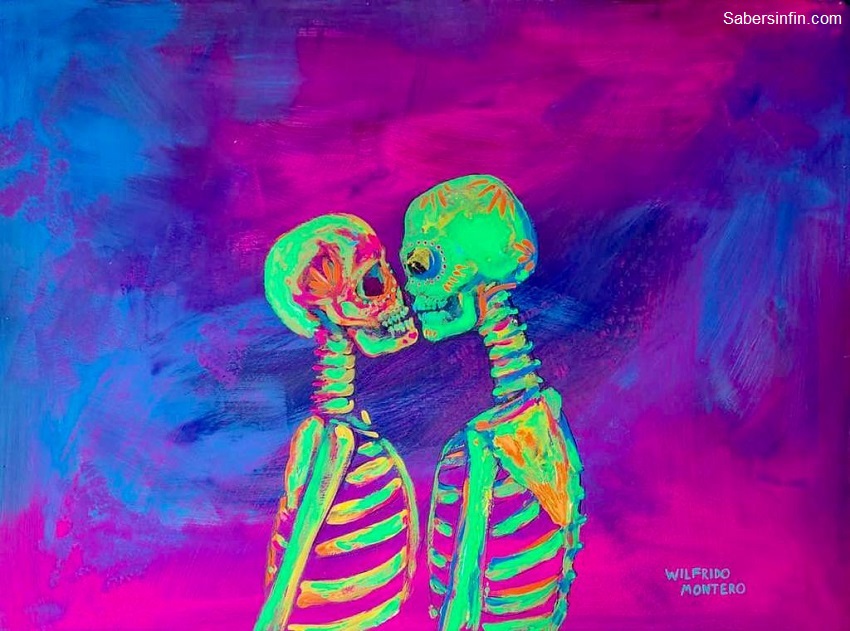
For a long time, man has wondered how it is that wonderful feeling that we call infatuation arises, that desire to feel the other physically and mentally, that need to feel the waves of his body and the seas of his passion, that feeling that slowly transforms into the need to caress.
Of possessing and that generates the hunger to kiss and that builds dreams and accumulates that sexual energy that waits to be released in a majestic orgasm.
Although also, like all mental events, especially emotions, they have a time of validity and that happens to falling in love, which after a certain time, is devoured by oblivion, as Gustavo Adolfo Bécquer (Seville, February 17, 1836 – Madrid, December 22, 1870) said: “Love is so short and oblivion is so long” and ends up altering consciousness, transforming into suffering.
But how do we fall in love? Plato (427 BC-347 BC). Greek philosopher said that falling in love is an emotion that makes man feel a lot and talk little, Plato proposed that all feelings are built in the heart, so this philosopher maintained that falling in love is one of the functions of the heart.
However, Bécquer himself said that the “heart is a machine that makes noise to the rhythm that moves” and that it has no relation to love. More recently, in the age of neuroscience (second half of the twentieth century), it has been proposed that the process of falling in love depends on different brain structures and their different hormones, depending on the different components of love. So when we say I love you.
This feeling is built in the anterior part of the frontal lobe, where impulses, judgment, language production, working or short-term memory, motor functions, part of sexual behavior, socialization, spontaneity, planning, and execution of wanting are controlled. The hormones and transmitters that participate in the feeling of wanting are multiple, since this feeling depends on all the functions listed, however we can mention the participation of serotonin, acetylcholine, dopamine, neurotensin, glutamic acid and GABA among others.
When we say I miss you, we are rescuing memories of the hippocampus, where short-term actions were transformed into permanent memories, where every look, every kiss and every caress was incorporated into our body, our skin and built permanent tattoos that will be almost impossible to erase.
The hormones that build the feeling of missing are thought to be acetylcholine and endorphins. When we say I suffer yes and it’s because of you Thinking that I lost you, the cingulate is activated, where the emotions of pleasure induced by physical contact and attachment by psychological interaction are integrated, it is the brain area where they integrate the sensations of body touches, kisses and caresses and give a response of pleasure including erections of the penis and when the loved one is lost this structure allows us to experience pain physical and psychological abuse, anxiety, fear, and aggression.
The brain structure that is activated is the amygdala, where the image of the erotic silhouette is encoded and sexual desire is generated, it is where the sexual experiences of life are stored, including the construction of sexuality and pleasure. It is where the sight integrates eroticism into a beautiful silhouette, where the touch in contact with the curves of the skin generates passion and where the taste of the honeys of love and the fragrances of pudendum that are carried through the smell is stored.
It is important to mention that all these nerve structures are intimately connected to carry out the processes of falling in love and that each of the components of love induce the secretion of hormones, kisses cause a rush of dopamine, dreams a cascade of anandamide, caresses a sea of endorphins and oxytocin leads sexual energy to its maximum release through orgasm.
Finally, it is important to consider the involvement of the exo-brain in the process of falling in love, so we must admit that to fall in love requires a little friction and a lot of imagination.
Lectures
The Mysteries of Love: Decoding the Secrets of the Heart
Victoria ‘The Love Guru’ Foster 2005
 Enrique Canchola Martínez. Metropolitan Autonomous University. México City. México